


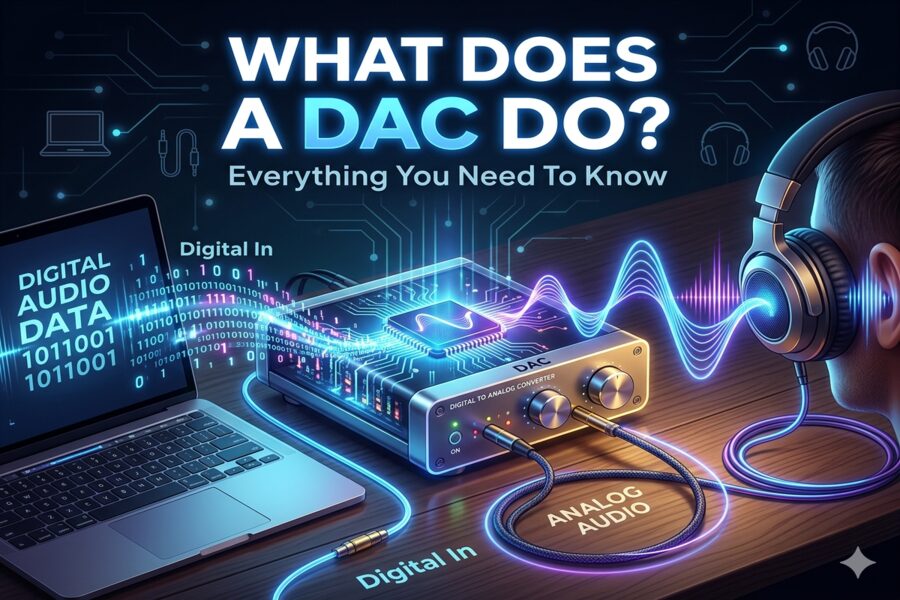
DAC stands for Digital-to-Analog Converter. In the simplest terms, a DAC takes digital audio data—the ones and zeros stored on your phone, computer, or streaming service—and converts them into an analog electrical signal that your speakers or headphones can actually use to produce sound.
Here’s why this matters: all audio that exists in the digital world needs to be converted before you can hear it. Every smartphone, laptop, and smart TV has a built-in DAC doing this job quietly in the background. But not all DACs are created equal. The quality of that conversion process directly determines the quality of the sound you hear.
Think of it this way—digital audio is like a set of instructions written in binary code. Your ears can’t read binary. A DAC is the translator that turns those instructions into something your ears can actually experience.
How Does a DAC Work? A Simple Breakdown
When music is recorded digitally, it’s captured as a series of samples—snapshots of the audio waveform taken thousands of times per second. A CD, for example, captures 44,100 samples per second (44.1 kHz). Hi-res audio can go much higher — 96kHz, 192kHz, or beyond.
Each sample is stored as a binary number, representing the amplitude of the sound wave at that moment. The DAC reads these numbers in sequence and reconstructs the original analog waveform by converting each digital value back into a corresponding voltage level. When done well, the result is a smooth, continuous analog signal that closely mirrors the original sound.
The more precise and well-engineered a DAC is, the closer the reconstructed signal gets to the original recording. That’s where dedicated external DACs—like those from Bel Canto—come in. They use far more sophisticated circuitry, higher-quality components, and advanced filtering algorithms compared to what you’ll find in mass-market consumer electronics.
A DAC doesn’t just “play music”—it faithfully reconstructs the emotional texture of a recording. A great DAC lets you hear the breath before a vocal phrase, the decay of a piano note, and the air in a concert hall.
Why Does DAC Quality Matter So Much?
You might be wondering—if every device already has a DAC built in, why bother with a dedicated one? The answer comes down to one thing: compromise. Built-in DACs in smartphones, laptops, and even mid-range audio equipment are designed with cost constraints in mind. Manufacturers balance price, power consumption, and space — audio fidelity often comes last.
The Problem With Built-In DACs
The DAC inside your smartphone shares a circuit board with a cellular radio, a GPU, and dozens of other components, generating electrical noise. That noise can bleed into the audio signal, causing distortion, hiss, and a general muddiness in the sound. You might not notice it immediately — but switch to a quality external DAC, and you’ll be hard-pressed to go back.
Common issues with low-quality or built-in DACs include:
- Audible noise floor — a faint hiss in quiet passages
- Loss of fine detail in complex musical passages
- Compressed soundstage — music feels “flat” and narrow
- Poor channel separation — left and right channels bleed into each other
- Harsh or fatiguing high-frequency reproduction
What a High-Quality DAC Improves
A dedicated, high-performance DAC addresses all of these shortcomings. The improvements are often described as transformational by people hearing them for the first time. Specifically, a quality DAC contributes to:
- A blacker, quieter background—silence between notes actually sounds silent
- Greater dynamic range — the contrast between soft and loud passages becomes more dramatic
- Enhanced detail retrieval — subtle textures, reverb trails, and micro-dynamics become audible
- Natural, three-dimensional soundstaging — instruments feel like they occupy real space
- Reduced listening fatigue — music becomes a pleasure to listen to for hours
Types of DACs: Which One Is Right for You?
Not every DAC serves the same purpose, and the market offers a wide range of form factors to suit different setups and listening environments.
Desktop / Standalone DACs
These are the workhorses of the high-fidelity world. Sitting on your desk or in your equipment rack, standalone DACs connect to your source (computer, streamer, CD transport) and output an analog signal to your amplifier or powered speakers. This is where brands like Bel Canto truly shine—their desktop DAC units pack reference-level conversion technology into elegant, refined enclosures built for serious listening.
DAC/Amplifier Combos (DAC/Amp)
Some units combine a DAC and a headphone amplifier in a single chassis. These are popular with headphone listeners who want a streamlined, high-quality desktop setup without needing multiple separate components.
Network Streamers with Built-In DACs
Many modern network streamers include a high-quality DAC onboard, letting you stream music from Tidal, Qobuz, Spotify, or a local NAS drive directly to your amplifier—all in one box. For those embracing digital streaming without wanting a tangle of cables and components, these offer an elegant solution.
Portable DACs
Compact USB-powered DACs designed for use with smartphones and laptops. While they won’t rival a full-size desktop unit, a good portable DAC is a massive step up over a phone’s built-in chip—especially for serious headphone listening on the go.
DAC Specifications: What to Look For
Shopping for a DAC involves navigating a range of technical specifications. Here’s what actually matters—and what you can safely ignore.
Signal-to-Noise Ratio (SNR)
Measured in decibels (dB), this tells you how loud the signal is relative to the background noise. Higher is better — look for 110dB or above in a quality DAC.
Total Harmonic Distortion + Noise (THD+N)
This measures how much unwanted distortion the DAC introduces into the signal. The lower this number, the cleaner the output. A figure below 0.001% is excellent territory.
Supported Sample Rates and Bit Depths
If you listen to high-resolution audio (FLAC, DSD, MQA), ensure your DAC supports the formats you use. Most quality DACs today handle up to 32-bit/384kHz PCM and DSD256 or higher.
Inputs and Connectivity
Check what input types you need — USB, coaxial S/PDIF, optical TOSLINK, AES/EBU, or Bluetooth. Match the DAC’s inputs to your source devices to avoid the need for adapters.
Specs are useful as a baseline, but always trust your ears. Two DACs can have nearly identical measurements and sound noticeably different in practice. The best DAC is the one that makes you lose yourself in the music.
Bel Canto DACs: Reference-Level Conversion for Discerning Listeners
When it comes to DAC technology that genuinely delivers on its promise, Bel Canto Design has been a benchmark in the audiophile community for decades. Based in Minneapolis, Bel Canto has built a reputation for combining rigorous engineering with a musical philosophy—their DACs don’t just measure well, they sound right.
What sets Bel Canto DACs apart is their attention to the analog output stage. Many manufacturers invest heavily in the digital circuitry but cut corners on the analog side—Bel Canto treats both with equal care. Their designs use discrete, high-quality analog output stages that preserve the delicacy and dynamics of the converted signal all the way to your amplifier.
At Ultimate Audio AZ, we carry a curated selection of Bel Canto DACs precisely because they represent the kind of no-compromise approach to digital audio that our customers demand. Whether you’re taking your first step into high-fidelity digital audio or upgrading from a good DAC to a great one, Bel Canto offers a clear and rewarding path.
Final Thoughts: The DAC Is the Gateway to Great Sound
In the modern world of digital audio, a DAC isn’t optional—it’s fundamental. Every digital audio signal you’ve ever heard was converted by one. The question has never been whether you need a DAC but whether the one you’re using is doing justice to the music you love.
A high-quality DAC doesn’t just change how music sounds. It changes how music feels. It puts you back in the room with the musicians, brings out emotions buried in recordings you’ve heard a hundred times, and makes every listening session feel like a discovery.
That’s not audiophile hyperbole — that’s the reality for anyone who has made the upgrade. And if you’re ready to find out what your music really sounds like, we’re here to help you take that step.