


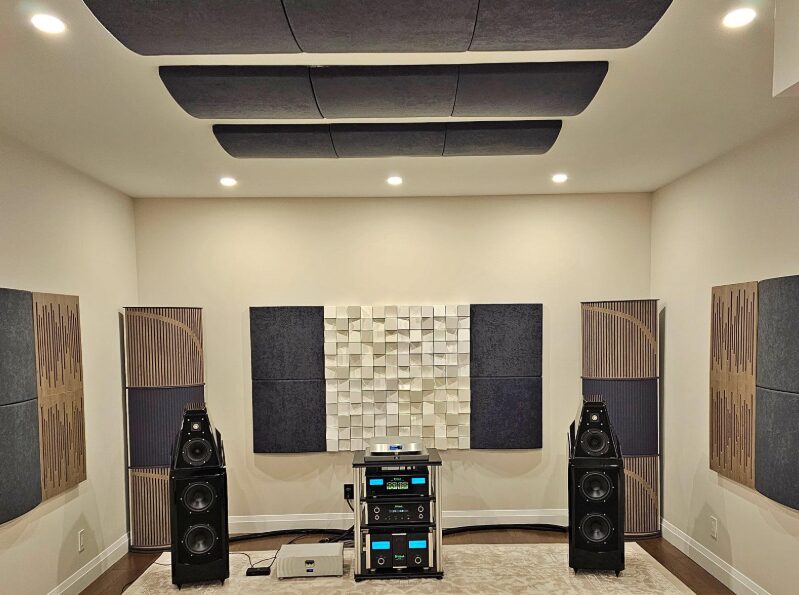
You can spend thousands of dollars on speakers, amplifiers, DACs, and cables and still wonder why your audio system does not sound the way you expected.
One of the most overlooked reasons is sitting all around you:
Your room.
A high-performance audio system does not exist in isolation. Once sound leaves your speakers, it interacts with walls, floors, ceilings, furniture, windows, and other surfaces before reaching your ears.
That means the room itself becomes part of the audio system.
In 2026, room correction and acoustic optimization are becoming increasingly important in both home theater and two-channel audio. Automatic room calibration, DSP-based correction, and intelligent tuning are appearing across a wider range of modern audio products.
For serious listeners, understanding the relationship between speakers and room can be just as important as choosing the components themselves.
Why Does the Room Matter So Much?
Imagine placing the same pair of speakers in two completely different rooms.
In one room, the speakers may sound balanced, open, and controlled.
In another, the same speakers may sound boomy, bright, thin, or lacking in detail.
The speakers did not change.
The room did.
Sound waves reflect from surfaces and interact with one another. Depending on the dimensions and materials of the room, some frequencies can become exaggerated while others may seem weaker.
This is one reason two people can purchase the same speaker and have completely different experiences.
Bass Is Often the Biggest Problem
Low frequencies are particularly challenging.
Bass wavelengths are long, which means they interact strongly with room dimensions.
You may notice this when moving around a room while music is playing. At one location, bass might sound powerful. Move several feet away and it can suddenly sound much weaker.
This is related to room modes and standing-wave behavior.
Adding a more powerful subwoofer does not necessarily solve the problem.
In some cases, it can make the problem more obvious.
The objective is not simply to create more bass. It is to create controlled, even bass.
Speaker Placement Comes Before Technology
Before turning to digital correction, start with physical placement.
Your speakers need enough breathing room from nearby walls, and their positioning relative to the listening position can significantly affect imaging and tonal balance.
This is particularly relevant to high-performance speakers such as those offered by Alta Audio.
Ultimate Audio AZ already emphasizes speaker placement and room considerations in its educational content, including previous discussion of the 1/3 speaker rule and selecting speakers for different rooms.
The exact placement depends on the speaker and room.
There is no universal measurement that works perfectly for every setup.
What Is Room Correction?
Room correction uses measurement and signal processing to compensate for certain acoustic problems created by the room.
A calibration system can measure how your speakers behave at one or more listening positions and then apply digital processing designed to improve the resulting response.
Modern room correction technologies are becoming more common in home audio.
Current products and industry developments increasingly combine room calibration with network streaming, wireless systems, and integrated amplification.
The important point is that room correction is not magic.
It cannot completely transform a poor room into a perfect acoustic environment.
Instead, it can be another tool within a broader system-design strategy.
Acoustic Treatment vs. Digital Correction
These two concepts are sometimes confused.
Acoustic Treatment
Acoustic treatment changes the physical behavior of sound in the room.
Examples include:
- Absorption panels
- Bass traps
- Diffusion
- Strategic furniture
- Rugs
- Curtains
- Other acoustic materials
Digital Room Correction
Digital correction changes the signal being sent to the speakers.
It may use DSP to compensate for certain frequency-response problems measured within the room.
The two approaches can work together.
Physical treatment addresses the environment.
Digital correction can then fine-tune the system.
Does Room Correction Make Expensive Speakers Unnecessary?
Absolutely not.
Room correction does not replace speaker quality.
A great speaker still needs to be capable of producing accurate, dynamic, detailed sound.
Likewise, an excellent amplifier cannot compensate for every acoustic issue.
The best results usually come from combining good equipment with intelligent setup.
Ultimate Audio AZ describes its home audio approach around premium components, tailored solutions, local expertise, and professional setup.
That philosophy is particularly relevant when dealing with room acoustics.
Why Listening Position Matters
Your listening position is almost as important as your speaker position.
If you sit directly against a wall, low-frequency response can change dramatically.
If you sit too close to one speaker, stereo imaging may become unbalanced.
If your speakers are positioned too far apart relative to your listening distance, the center image can become disconnected.
The objective is to create a listening triangle in which the left speaker, right speaker, and listening position work together.
Small adjustments can sometimes produce surprisingly noticeable differences.
The Importance of Stereo Imaging
A well-designed stereo system should not simply sound like two speakers producing music.
Ideally, instruments and voices should appear to occupy specific positions within a soundstage.
You might perceive:
- A vocalist in the center
- Guitar slightly to one side
- Percussion extending across the soundstage
- Ambient information surrounding the performance
Room reflections and speaker placement can interfere with this effect.
This is why a properly configured listening room can make a high-quality recording feel much more realistic.
Room Correction in 2026
The trend toward intelligent room optimization is becoming increasingly visible across the audio industry.
At CES 2026, audio companies showcased systems combining immersive audio, wireless speakers, automatic tuning, and room-adaptive processing. Research into current audio products also shows room calibration becoming more common outside traditional home-theater receivers.
This represents an important change.
Room correction is no longer only something associated with complicated professional installations.
It is increasingly becoming part of mainstream premium audio design.
Should You Use Automatic Calibration?
Automatic calibration can be extremely useful, particularly when:
- Your room has difficult acoustics
- Speaker placement is restricted
- You have strong bass peaks
- You want repeatable setup
- You are building a multi-channel system
- You want to optimize a broader listening area
However, automatic calibration should not be treated as a substitute for listening.
After calibration, it is worth listening to familiar recordings and evaluating whether the system actually sounds more natural and engaging.
Technical improvement and musical enjoyment should work together.
How to Improve Your Room Without Remodeling It
You do not necessarily need to build a dedicated recording studio.
Start with simple changes.
1. Move the Speakers
Experiment with distance from the front and side walls.
2. Adjust Toe-In
Small changes to speaker angle can influence imaging and high-frequency presentation.
3. Move the Listening Position
Try moving your chair forward or backward.
4. Add Soft Furnishings
Rugs, curtains, and upholstered furniture can influence reflections.
5. Address Bass Problems
If bass sounds uneven, experiment with speaker placement and listening position before simply increasing bass output.
6. Consider Room Correction
Once the physical setup is optimized, digital correction can provide additional refinement where appropriate.
How the Right Components Fit Into the Room
Room optimization should begin before purchasing equipment.
This is especially important when selecting speakers.
A speaker that performs beautifully in a large listening room may not be the ideal choice for a compact space.
Likewise, an amplifier should be selected based on the speakers and listening requirements rather than power numbers alone.
Ultimate Audio AZ’s product range includes Alta Audio speakers, Bel Canto amplification and DAC products, ToneWinner amplifiers, Cardas cables, and NuPrime products.
The advantage of working with a specialist is that individual components can be considered as part of a complete system.
Room Correction Is About More Than Frequency Response
When people talk about room correction, they often focus entirely on graphs.
Graphs are useful.
But music is not a graph.
A successful setup should also provide:
- Stable imaging
- Natural vocals
- Controlled bass
- Clear detail
- Good dynamics
- Realistic depth
- An engaging presentation
The ultimate test is whether you enjoy listening.
If you find yourself forgetting about the system and focusing on the performance, you are probably moving in the right direction.
Tucson Homes and Real-World Listening Rooms
Every home is different.
A Tucson living room may have an entirely different acoustic character from a dedicated listening room. Tile floors, large windows, open layouts, high ceilings, and furnishings can all influence the way sound behaves.
That is why a one-size-fits-all setup guide has limitations.
A listening room gives you an opportunity to hear what different components can actually do under controlled conditions.
Ultimate Audio AZ specifically offers by-appointment listening rooms in Tucson, giving customers the opportunity to experience high-performance audio before making purchasing decisions.
Final Thoughts
The room is one of the most important components of any home audio system—even though you cannot purchase it from an audio showroom.
Before upgrading an amplifier, replacing a DAC, or purchasing new speakers, take a serious look at your room.
Where are the speakers?
Where are you sitting?
How much sound is being reflected?
Is the bass even?
Are the left and right channels balanced?
Would acoustic treatment help?
Would room correction provide additional refinement?
Answering these questions can sometimes produce a bigger improvement than simply buying another expensive component.
For audiophiles looking to build a truly high-performance system in Tucson, the best approach is to consider the room, speakers, amplification, source, and setup as one complete system.
That is how you move from simply owning expensive audio equipment to actually creating an exceptional listening experience.